
Arrest Warrants in Clarke County
Under Iowa Code chapter 804, the process begins when a complaint and supporting information go to a magistrate. The magistrate reviews those facts. Probable cause is the standard. It means a lawful factual basis to believe the named person committed the stated offense. If the facts meet it, the magistrate may issue a warrant. That order directs a peace officer to arrest. Iowa law also allows a citation instead of immediate arrest in some circumstances. A citation and a warrant are not interchangeable. The court record must be read for the actual document, charge, and event. Clarke County posts no live public warrant database. A warrant search in Clarke County starts with Iowa Courts Online and continues with the Clerk or the serving agency.
Clarke Arrest Warrant Judicial Review
Clarke County sits in Judicial District 5. Iowa assigns work among magistrates, district associate judges, and district judges according to the case and governing law. A magistrate can issue search warrants and conduct preliminary proceedings. One officer does not handle every Clarke County arrest warrant. Assignments change over time. The official District 5 judges and magistrates directory lists the current public assignments, so check it before assuming who signed a given order.
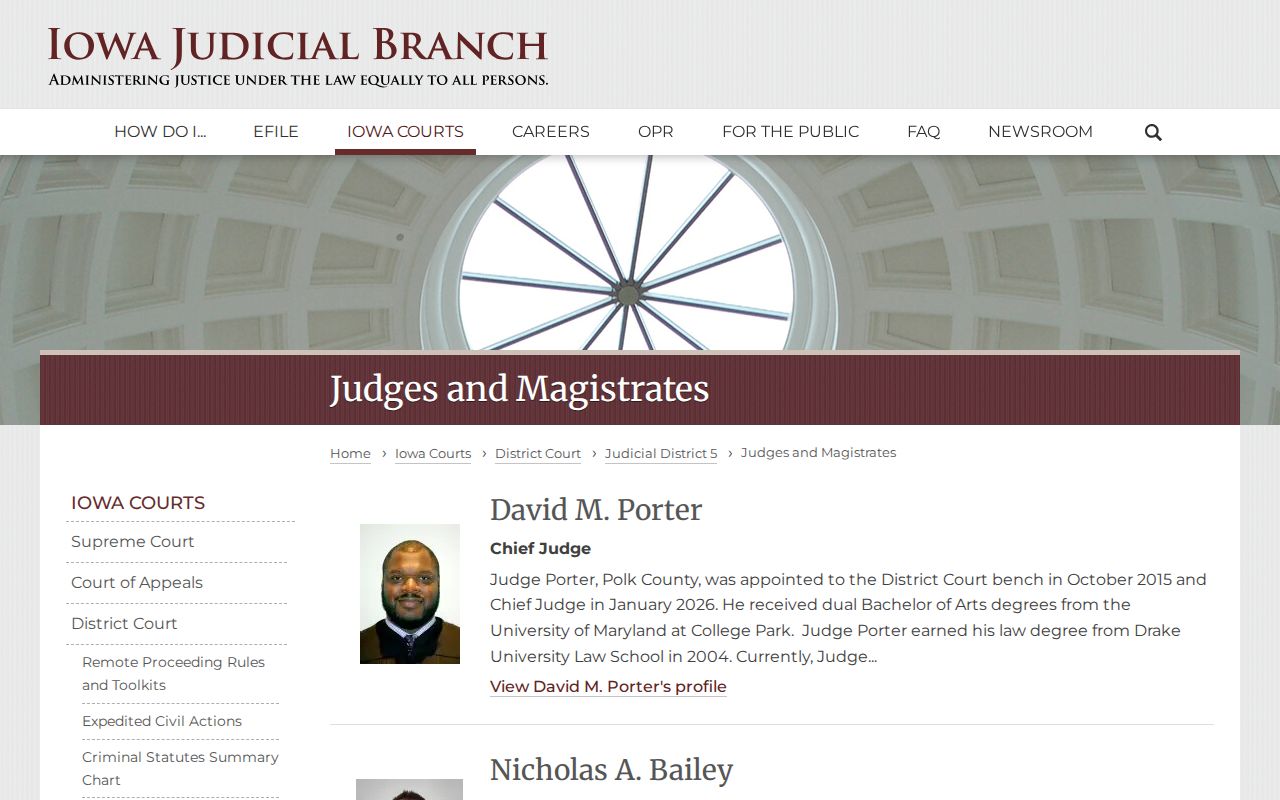
The directory shows court structure only. It does not prove that a specific warrant exists. Work from the case ID and docket to identify the judicial action, then ask the Clarke County Clerk of Court which public record can be inspected or requested.
What a Clarke County Arrest Warrant Contains
Section 804.2 sets out what an arrest warrant must contain. A public result may show only part. Private databases are not a substitute for the court file. In Clarke County, a generic placeholder such as CLARKE-CASE-ID can stand in for a case number without implying any local format.
| Named accused | Identification of the person the warrant concerns |
|---|---|
| Offense | The charged offense or a general description |
| Direction | An instruction to a peace officer to arrest |
| Date and place | Date plus the county or city tied to issuance |
| Judicial signature | The magistrate's signature and office |
| Bail or conditions | Any endorsement made under section 804.3 |
Docket fields can include case type, charge count, filed date, indexed judge, status, bond event, service return, and disposition. Not every field appears. A Clarke County result may leave some out. Bonds and service returns may require an Iowa Courts Online subscription.
Clarke Arrest Warrant Access Limits
A Clarke County case can be public while its warrant application is not. Iowa Code section 804.29 keeps arrest-warrant application information confidential until a peace officer arrests the person and files the return, or until the defendant's initial appearance, subject to statutory exceptions. That rule protects an unexecuted warrant. It applies in Clarke County like the rest of Iowa.
Key point: A visible case is not proof of current warrant status, and a missing application is not proof that no Clarke County warrant exists.
Juvenile records stay generally confidential under chapter 232. So can sealed records and protected investigative information. Iowa Courts Online holds the public parts of official dockets, not every warrant packet or law-enforcement record. For Clarke County questions, ask the right office about lawful access rather than trusting one search screen.
How Clarke County Arrest Warrants Are Served
Section 804.4 lets an arrest warrant be delivered to a peace officer and served in any Iowa county. Section 804.6 makes the arrest a peace officer's job. Crossing the Clarke County line changes nothing. Local procedure picks the agency. The Clarke County Sheriff's Office sits at 220 Townline Road in Osceola, phone (641) 342-2914. Osceola Police shares the Law Enforcement Center and lists (641) 342-2121 for non-emergency routing. The Iowa Highway Patrol is another peace-officer agency listed by the county. The agencies do not share identical roles. Call before traveling if counsel advises a voluntary surrender.
After a Clarke Arrest Warrant
After an arrest, Iowa Code section 804.21 requires the person to be brought without unnecessary delay before the nearest accessible magistrate. That officer handles initial appearance and bond conditions. Timing and outcome vary. Exact results depend on the case, the custody setting, current law, and the judicial order in Clarke County.
- The peace officer executes the warrant and handles custody.
- The person is brought before an accessible magistrate.
- The court reviews identity, charge, counsel, and release issues.
- The docket later records public events that are not confidential.
Iowa publishes a Uniform Bond Schedule for some periods when court is not in session. Its figures guarantee nothing in Clarke County. Figures need current verification after legislative changes in 2026. Ask the court or counsel about the order in the actual case.
Arrest Warrant vs Summons vs Bench Warrant
These papers call for different responses. A Clarke County arrest warrant directs a peace officer to arrest after a probable-cause review. A summons directs an appearance, not an arrest. A bench warrant usually grows from a missed duty in a case already underway.
| Process | Usual basis | Required response |
|---|---|---|
| Arrest warrant | Probable cause for an offense | Seek counsel and plan a lawful response |
| Citation or summons | Charge handled without initial custody | Appear or respond by the stated date |
| Bench warrant | Missed appearance or unmet court duty | Confirm the case and address recall or appearance |
A search warrant is different again. It authorizes a search for property or evidence in Clarke County, not the arrest of a named person, and the docket label and signed order control.
Clarke Arrest Warrant Record Route
The official Clarke County court page lists the Clerk of Court at 100 South Main Street, Osceola, Iowa 50213. Phone: (641) 342-6096. Email goes to countyclerk.clarke@iowacourts.gov.
Iowa Courts Online comes first. Run a search by name, exact date of birth, case ID, or citation number. Then ask the Clarke County Clerk about public complaint, warrant, bond, and appearance entries on the docket. For records the sheriff holds, service questions, or surrender logistics, call the Sheriff's Office. Clarke County posts no dedicated warrant hotline or online roster.
Clarke Arrest Warrant Bond Limits
Bail in Clarke County is a framework for release, not one set figure. Under Iowa Code chapter 811, a defendant who qualifies can be released on personal recognizance or an unsecured appearance bond unless the court decides that is not enough. The judge may add conditions instead. Supervision, travel limits, cash, a surety, or other lawful terms can all be part of the order. Statutory factors and the facts of the case drive that call. So never trust an old schedule, a quote from a caller, or a private site's estimate of a Clarke County bond. Paying a fine, posting bond, and paying down court debt are three different events. Keep every official receipt, then check the docket afterward. A bond event alone does not show that each charge, warrant, or case duty has ended.
What to Do If There's a Warrant for You
Confirm the case before you act on a Clarke County warrant. Write the public case ID down privately, call the Clerk, and talk with a defense attorney. Counsel can weigh voluntary surrender, sort out any bond issue, and see whether a motion to recall or quash fits. The Clerk can identify records and explain routine procedure, but choosing a legal strategy is not the Clerk's role.
Important: Talk with counsel before surrendering; an active Clarke County arrest warrant may be served during any lawful peace-officer contact.
If surrender is the route, call the peace-officer agency first for current logistics. Clarke County posts no walk-in hours, no intake entrance, and no guaranteed release timetable. After any court action, get the public order or event and confirm the agency's status. And never pay a caller who threatens you with instant payment to erase the warrant.