
The Clarke County Most Wanted Program
A most-wanted program lets an agency put a handful of cases in front of the public and ask for help. The agency alone decides what to publish, which facts are safe to release, and how tips should come in. When circumstances change, it can pull or revise a notice. Clarke County publishes no such roster. The Clarke County Sheriff and the Osceola Police maintain official pages with contact details, but neither posts a named most-wanted list or an active-warrant roundup. So the practical route here is civic: call the office, ask about a warrant through the court that issued it, and send any tip through the channel the agency itself publishes. This page does not reproduce names, photos, mugshots, or addresses, and any named person keeps the process the law provides.
No Clarke County Most Wanted Roster Was Located
Clarke County publishes no named most-wanted roster and no public warrant database. Its public-safety page names Sheriff Rob Kovacevich and gives the Sheriff's Office telephone number. The Osceola Police page offers a non-emergency contact and communication channels but no list of wanted persons either. For current county contact details, use the official Sheriff and local departments page, which shows each department the county runs.

That county page is the route to the agencies themselves. It is not a warrant list, and phone staff cannot confirm every case.
Absence today proves little. An agency can issue a bulletin at any time. Before acting, go back to the official Clarke County or Osceola Police page and check the date, the agency name, and the current status of any notice.
How Clarke County Most Wanted Lists Work
When an agency keeps such a list, it is curated, not comprehensive. A case may earn a spot because investigators want information, the offense is serious, or the person cannot be found. Most active warrants never make a list at all. Clarke County publishes no selection policy, update schedule, reward program, or Crime Stoppers partnership, so assume none exists. Only the publisher can say why a notice ran and whether it is still current. A name comes off after an arrest, a surrender, a recall, a correction, or a simple publishing choice. A name that stays on does not prove the warrant is still enforceable. For a case, confirm with the issuing court. For enforcement, ask the named Clarke County agency.
Verify a Clarke County Notice Before Sharing
A Clarke County public-safety notice can spread long after the agency takes it down. Before sharing one, check the office's current website instead of a social-media repost or a search-result preview.
- Confirm the page belongs to Clarke County government, the Iowa Judicial Branch, Osceola city government, or another named public agency.
- Check the publication and update dates, agency seal, contact number, and any withdrawal notice.
- Compare the case reference with the public court index only when lawful and necessary.
- Call the agency's published main number if the notice lacks a current tip route.
- Do not save, mirror, annotate, or republish a roster on a private page.
A court docket and an agency bulletin do different jobs. One records public case events; the other seeks tips under Clarke County agency control.
How to Report a Clarke County Tip Safely
Send tips through the agency that published the notice. The Clarke County Sheriff's Office lists (641) 342-2914 at the Law Enforcement Center, 220 Townline Road, Osceola. Osceola Police lists (641) 342-2121 for non-emergency calls at the same building. Neither office runs a separate anonymous tip line or reward channel.
Safe reporting: Call 911 for an immediate threat. Otherwise use the official non-emergency number, give facts without approaching anyone, and follow the dispatcher's instructions.
Describe only what you saw yourself, with the place, the time, and a way for the agency to follow up. Do not investigate, trespass, follow anyone, or post a live location. Never promise anonymity or a reward. Offer those only if the official program itself does.
A Clarke County Tip Is Not a Records Request
A tip hands an agency information it may find useful. A public-record request asks a lawful custodian for an existing record under Iowa Code chapter 22. Mixing them can expose personal facts needlessly. It can also send urgent information to staff who dispatch no one.
| Purpose | Correct route | What to include |
|---|---|---|
| Immediate danger | 911 | Location and present facts |
| Non-emergency tip | Publishing agency | Observed facts and notice reference |
| Court case question | Clarke Clerk, (641) 342-6096 | Case number and public-record question |
| Existing agency record | Agency custodian | Record type and date range |
A records request cannot ask an agency to build a roster or judge who is dangerous. Public-record law still protects confidential and law-enforcement material in Clarke County.
Most Wanted vs an Active Clarke County Warrant
The two overlap only when an agency puts a wanted subject on an active Clarke County warrant into a public notice. Most active warrants never get picked, and a case docket is not a most-wanted program.
| Feature | Most-wanted notice | Active warrant |
|---|---|---|
| Purpose | Seek public help in selected cases | Authorize action stated by a court |
| Publisher | Law-enforcement agency | Court record; agency system may track service |
| Coverage | Small curated subset | Broader set not fully public |
| Currentness | Depends on agency update | Requires court and agency confirmation |
| Public access | Only facts the agency releases | Some documents and status details restricted |
For the broader distinction, consult the Clarke County active warrants process.
Clarke County Privacy and Presumption Rules
Iowa Code section 804.29 restricts certain arrest-warrant information before execution. Juvenile, sealed, and confidential records face further limits. Even public facts deserve care. A photo ages, a name can belong to someone else, and a Clarke County warrant may already be served or recalled.
Most-wanted notice: An agency publication seeking help in selected cases.
Public docket: An index of public case events that may omit warrant documents, bonds, and service returns.
Those limits are why no names or images appear here. Verification belongs with the original Clarke County court or agency.
Federal Notices Are Separate From Clarke County
Federal matters arising in this area run through the Southern District of Iowa, PACER, the U.S. Marshals Service, or the originating agency. A federal fugitive notice is not a Clarke County roster. A county office cannot confirm every federal record. Some federal warrant material stays sealed. Use the exact federal domain shown on the notice. Do not copy a federal name or image onto a local Clarke County page. The same no-confrontation rule applies, and the issuing agency controls corrections and removal.
If You Believe You Are on a Clarke County List
A rumor, a repost, or a dead link proves nothing about an active warrant. The public docket is only a starting point for a Clarke County warrant check. From there, let a defense lawyer call the Clarke County Clerk or the agency named in the case. Counsel can ask about the charge, the court appearance, bond, and safe surrender.
Act carefully: Do not approach an officer unexpectedly or pay a caller. Contact counsel and the official court or agency first.
The official Iowa Judicial Branch scam warning explains the fraud pattern.
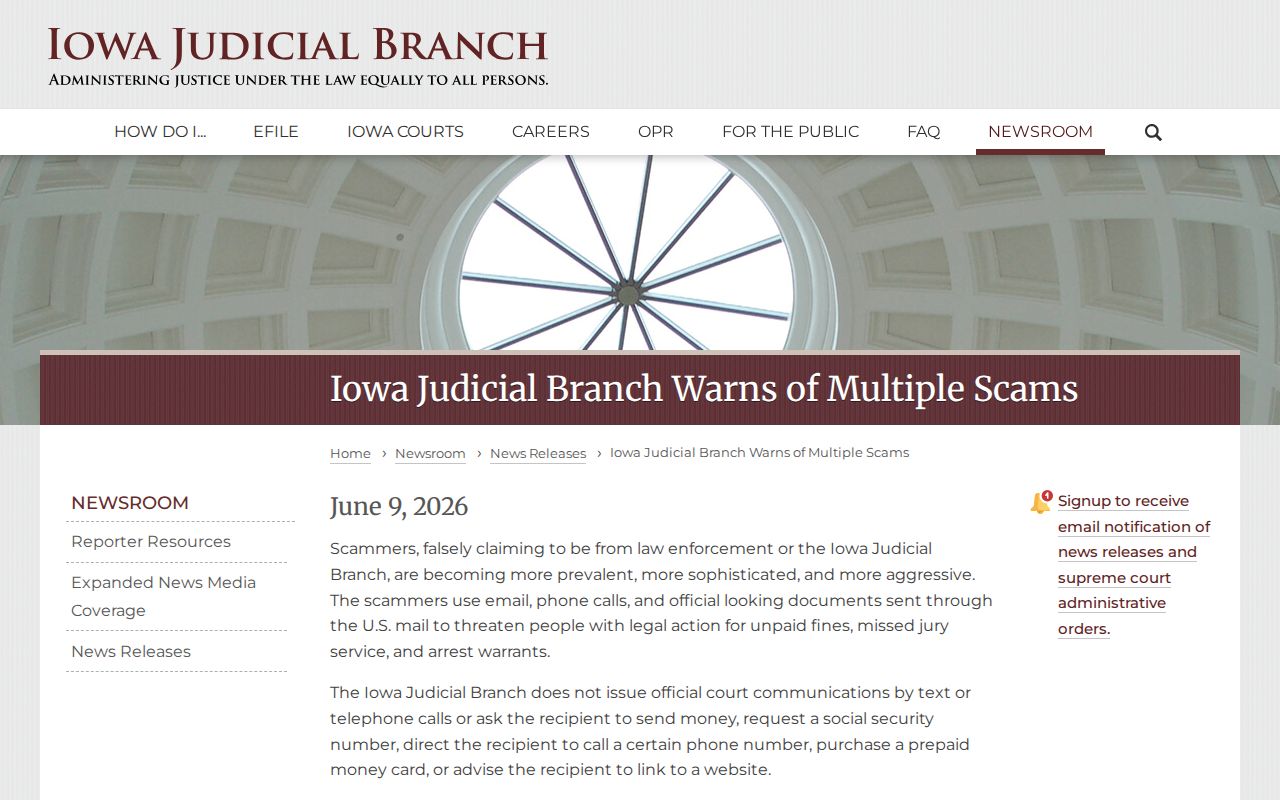
Scammers work this fear. Iowa courts warned in June 2026 about callers who claim you missed jury duty or have a warrant, then push for immediate payment. A convincing caller ID, an official name, or an urgent tone proves nothing. Real courts never demand gift cards, cryptocurrency, or a payment by phone to stop an arrest. After any court action in Clarke County, get direct confirmation. Never assume a payment or an appearance cleared the outstanding warrant.